Guide
System of Record for AI Agents
A system of record for AI agents is the one place where the business facts an agent produces are stored, attributed, and treated as authoritative — so every later decision, report, or agent run reads from it instead of from a chat log. A store earns that title when every write can be traced to who made it, what it changed, and how to undo it.
That is a property of the write path, not the storage engine. This page explains the distinction, gives five tests you can run against any candidate, and shows how Busabase answers them with one mechanism: every edit is a Change Request.
Last verified 13 November 2026
The short answer
What it is
What earns the title
Where Busabase fits
Two different things are called a “system of record for agents”
The phrase is used for two different jobs in 2026. Picking the wrong one wastes an evaluation, so start here.
| Agent System of Record (ASOR) | System of record for agent-written data | |
|---|---|---|
| What it governs | The agents themselves — registration, permissions, activity | The business records the agents produce |
| Closest analogy | A directory and HR system for non-human workers | The authoritative workspace people and agents both read and write |
| The question it answers | “Which agents are running, with what access, and are they working?” | “Is this record true, who changed it, and what did it say before?” |
| Who to look at | Workday sells a product under this name; agent registries and catalogs do the same job | Busabase, or a database plus the audit, review, and interface layers you build yourself |
If leadership wants an inventory of every agent running in the company, an agent registry is the right category and Busabase is not it. The rest of this page is about the second job: agents producing real work that your business should be able to rely on.
Why agents make this urgent
Systems of record are not new. What changed is the write rate.
A team writing into a shared database works at human speed, and mistakes get caught by the same friction that slows the writing down. An agent can produce two hundred plausible, well-formatted rows in a minute — and a plausible wrong record is more dangerous than an obviously broken one, because nothing about it invites a second look.
So the honest framing is not “agents need a database.” Agents already have databases. At agent write speed, storage is the easy half; knowing what changed, who changed it, and how to reverse it is the part that breaks.
What makes a store authoritative: the write path
When two sources disagree, the system of record wins. Three properties earn that authority, and all three belong to the write, not to the storage:
- Attribution. Every record can name its source — not “API key 7,” but which agent, acting through which key or tool, with what message.
- Accountability. A person is answerable for the record in its current form: they wrote it, they gave the agent write access, or they approved the change.
- Reconstructability. You can replay how the record reached its current state, compare any two versions, and roll a change back.
Put those together and the shape is one developers already know: a pull request, applied to data instead of code. A diff of exactly which fields changed. An author. An optional review where the stakes justify one. A merge that is recorded, never a silent overwrite. The same applies to what an agent knows — prompts, instructions, and Skills drift the way code does.
How Busabase builds the write path: every edit is a Change Request
In Busabase, every edit — a record, a Doc, a Skill file, a schema change — is a Change Request: a branch with a chain of immutable commits. Merging moves the record forward; nothing is overwritten. It does not matter whether the edit came from Claude Code over MCP, a script over the API, or a teammate in the browser.
Most databases answer the write question with permissions: a write is allowed or denied, and once allowed, the new value replaces the old one. A Change Request keeps both, plus who made the change and why.
- A message and a diff on every write. Each change says what it does and shows the field-level before and after.
- Know which agent did it. The author, and the key or tool the change came through, stay on the commit.
- Undo is built in. Records, Docs, and Skills keep their full history; merging never overwrites, and any change can be rolled back.
- Review when you choose. Writes with write access merge at once. Give an agent a proposal-only key, or send a change with
autoMerge: false, and it waits in the Inbox for a person to approve or send back. Read the Change Request docs.
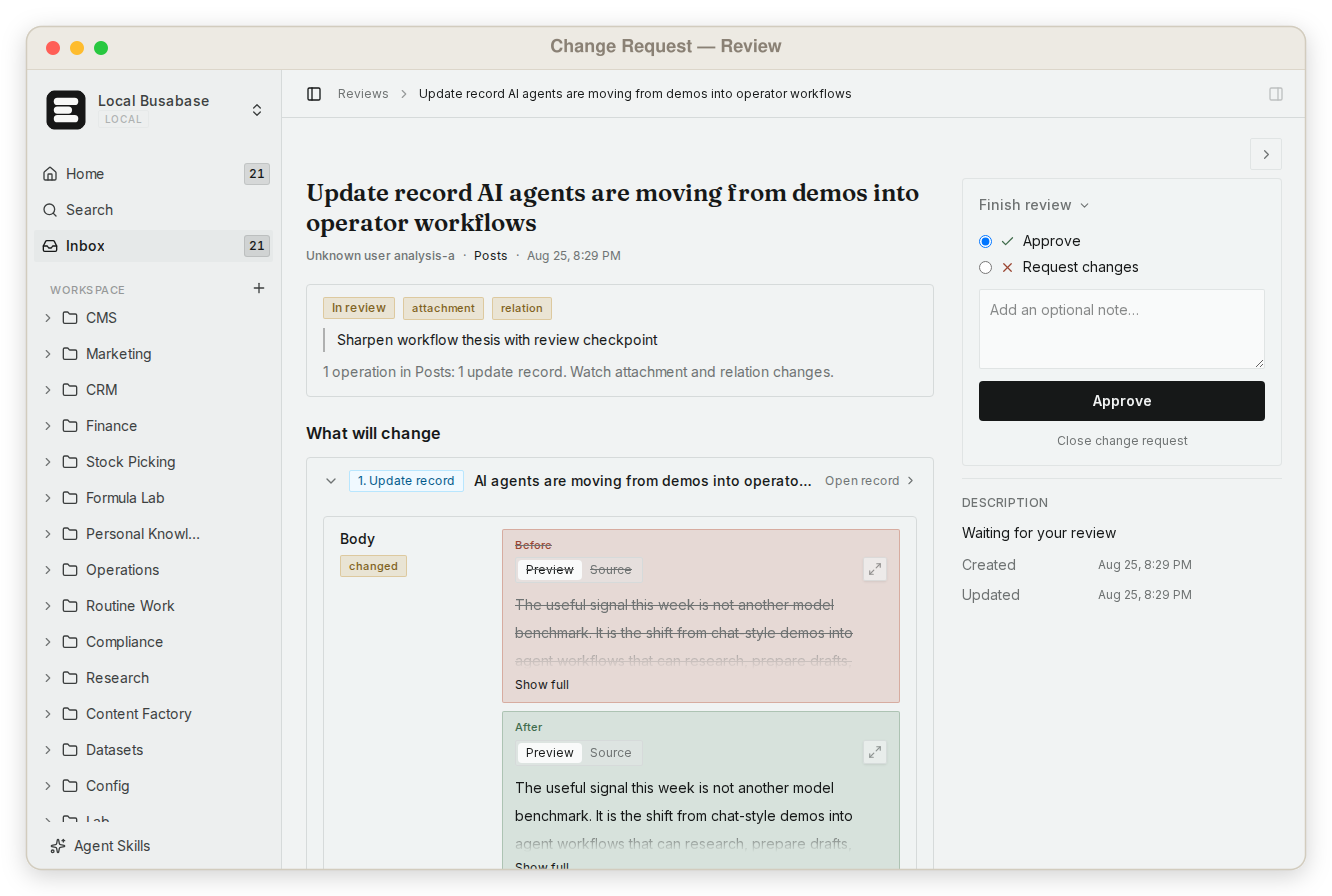
This is what lets you give agents real write access to the data your business runs on: nothing they change is untraceable, and nothing is irreversible.
Five tests to apply to any candidate
Run these against a database you maintain, a doc tool, a vector store, or Busabase. The right-hand column is how Busabase answers each one; the last row is the job it does not do.
| Test | What passing looks like | Busabase |
|---|---|---|
| 1. Can a write wait when you want it to? | A change can be stored and reviewable without being true yet — for the agents and records where that matters | Yes — a proposal-only key or autoMerge: false holds the Change Request in the Inbox; trusted agents merge at once |
| 2. Is the diff legible to a person? | A reviewer can judge 40 changed records in minutes | Yes — field-level before and after, with rich-text preview, on every change |
| 3. Does provenance survive the merge? | After a change lands, the record still knows its author, tool, and message | Yes — commits stay attached to the record permanently, rejected proposals included |
| 4. Can both people and agents use it? | Structured enough for an agent, legible enough for a person | Yes — Bases with real field types and visual views for people; MCP, CLI, and API for agents |
| 5. Can you leave? | Data, history, and files export in a usable form | Yes — MIT open source, self-hostable, and a space exports to Markdown, Base definitions, and JSON |
| Inventory every agent, its access, and its activity (the ASOR job) | A registry of agents | Not its job — use an agent registry such as Workday ASOR |
Test 1 separates the categories. Tools designed for human writers rarely have it, because a person who writes into a shared database has already applied judgment. In Busabase it is a setting per key, not a different product.
A system of record is more than a table
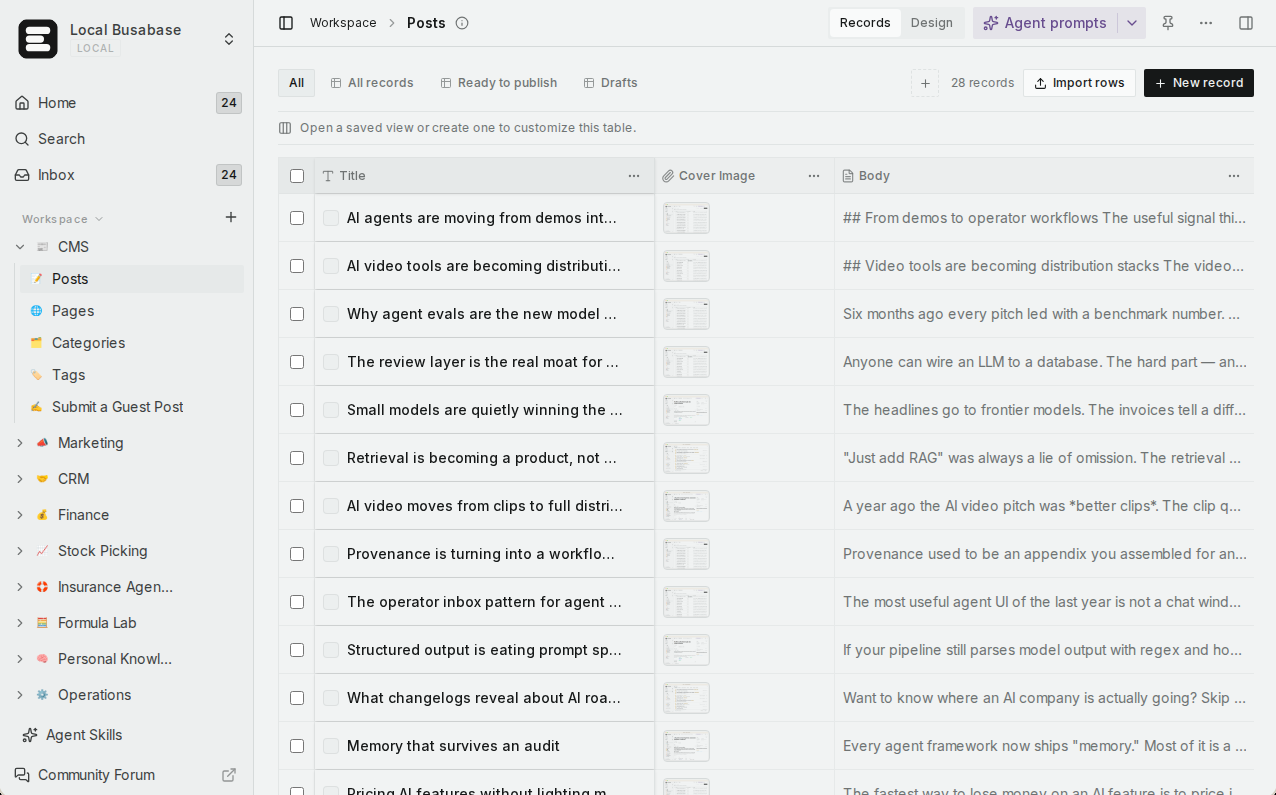
A business fact is rarely just a row. It comes with the policy behind it, the file it was derived from, and the instructions the agent followed. Busabase keeps them together:
Visual tables people can read
A team knowledge base
grep across everything
Shared team Skills
AirApps on live data
Websites on your own domain
Agents connect in minutes
Open source, runs anywhere
Flat, predictable pricing
Coming next
These are being built now. They are not available yet, and this page will say so until they ship.
App usersIn development
OntologyIn development
Fine-grained permissionsIn development
When Busabase is not the right choice
- You need an agent registry, not a data store. That is the ASOR category described above.
- Your writes are high-frequency machine telemetry or an app's transaction path. Events, logs, metrics, or checkout writes belong in a database built for that shape — see which database your agent should use.
- You need pure semantic recall. “Find the passage that resembles this question” is a vector store's job. It is good for retrieval and has no opinion about whether the passage is true.
Plain limits today: Busabase has no realtime subscriptions or vector index, and sign-in for end users of the apps you publish is still in development.
Frequently asked questions
Is a system of record for AI agents just a database?
How is this different from an agent's memory?
Do agents need approval for every write?
Can multiple agents share one system of record?
What happens to a rejected change?
Can I run it on my own infrastructure?
Next step
The fastest way to judge any of this is to run one real change through it: connect an agent, let it edit a record, and read the Change Request it leaves behind.
Related: Change Requests · Compare Busabase · Busabase vs Supabase · Busabase vs Notion · Which database for AI agents · What is an agent workspace
Sources: Workday Agent System of Record