Comparison
Busabase vs Hindsight for AI Agents
Hindsight, from Vectorize, is agent memory that learns: it extracts facts from what an agent sees, consolidates them into observations, and keeps rewriting what it believes as new evidence arrives. Busabase is where your agents and your team keep the work itself — records, docs, Skills, and apps — and every change, from a person or an agent, arrives as a Change Request someone can read and roll back.
One is a memory that updates itself. The other is a set of records your team inspects and owns. They answer different questions, and plenty of teams will run both; this page compares them by the jobs people bring to them.
Last verified 13 November 2026 against Vectorize's pricing and product pages, the Hindsight documentation, billing docs, blog, and GitHub repository, and Busabase's current product.
The short verdict
Choose Busabase when
Choose Hindsight when
Use both when
The core difference: every change is a Change Request
Think of it as a pull request for your data. In Busabase, every edit — a record, a Doc, a Skill file, a schema change — is a Change Request: a branch with a chain of immutable commits. Merging moves the record forward; nothing is overwritten.
Hindsight is designed to change on its own. After an agent retains something, “Hindsight automatically consolidates related facts into observations”, and a background worker keeps refining them as evidence piles up. Mental models and pages go a step further: “You define the question once; Hindsight writes the answer, keeps it stored, and rewrites it in the background as the bank learns more.” It keeps a real trail — observations are refined rather than overwritten, mental models keep their previous versions, raw facts are preserved, and you can edit, invalidate, or restore a fact afterwards. What it has no step for is a person reading a change to a belief before it applies. That is the point of a memory that learns, and it is the opposite of a record a team signs off on.
- A message and a diff on every write. Each change says what it does and shows the field-level before and after.
- Know which agent did it. The author, and the key or tool the change came through, stay on the commit.
- Undo is built in. Every record, Doc, and Skill keeps its full history, and any change can be rolled back.
- Review when you choose. Writes with write access land immediately. Give an agent a proposal-only key and its changes wait in the Inbox for a person to approve or send back.
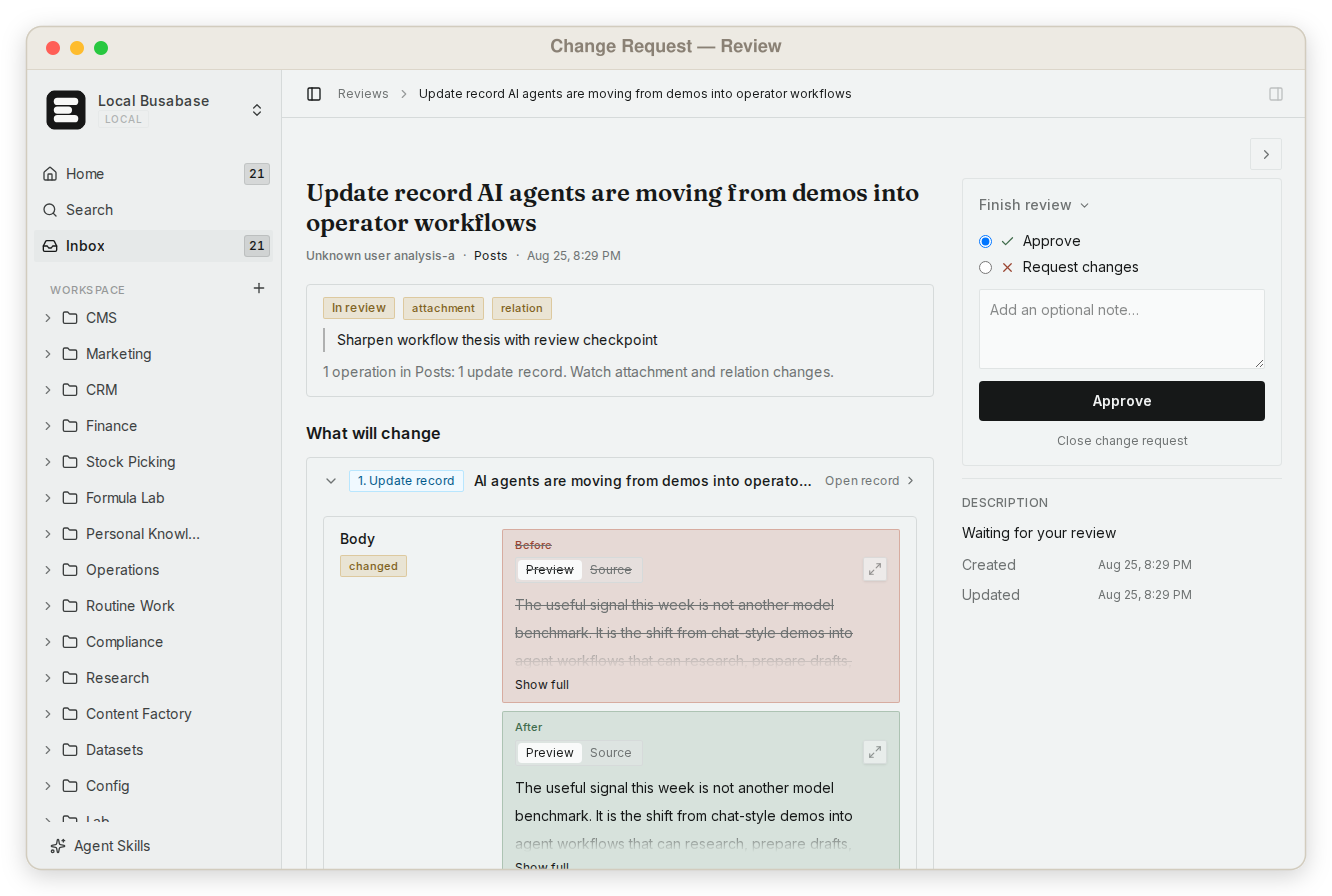
In one line: Hindsight rewrites what the agent believes so the agent gets smarter; Busabase changes a record only through a Change Request, so the team can see — and, if it wants, approve — every step.
What else Busabase gives your agents and your team
A memory engine makes one agent smarter. These are the things a team needs around all of its agents' work, and in Busabase they come with the workspace.
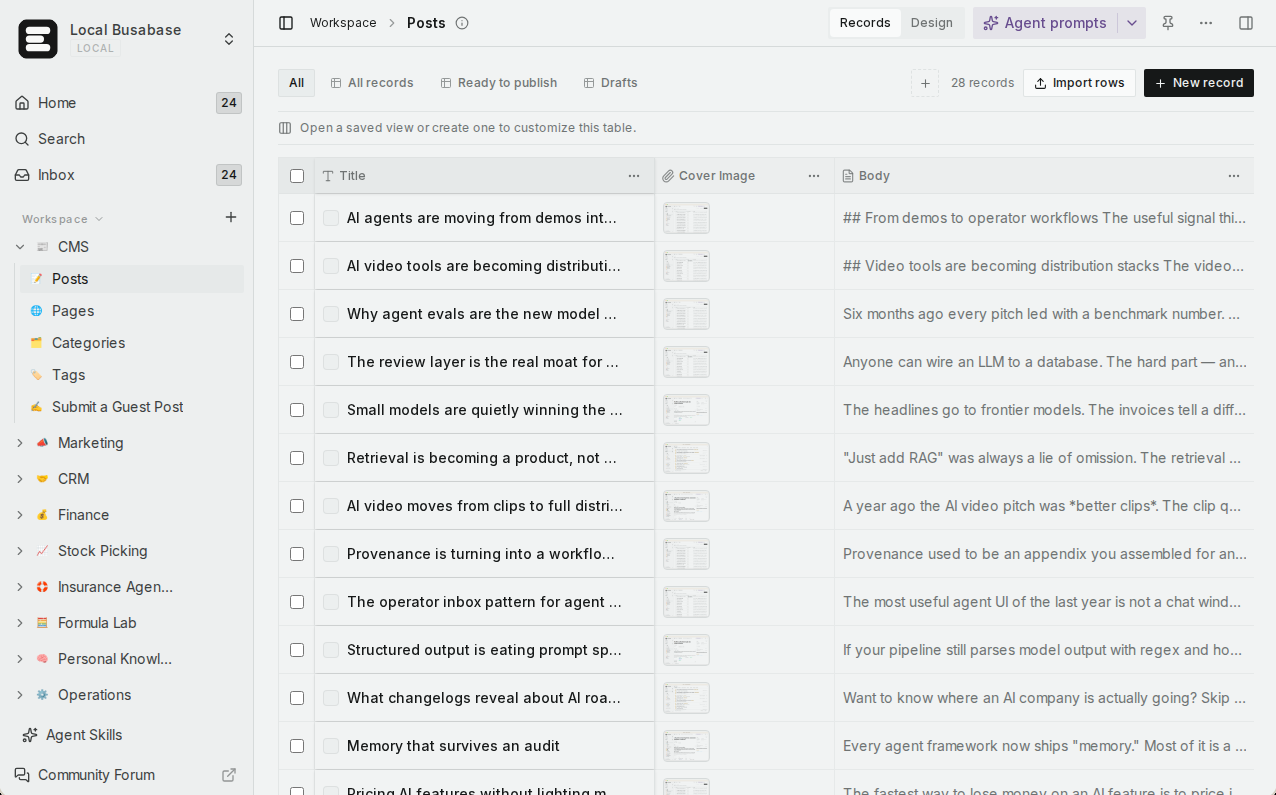
Visual data tables
A team knowledge base
Grep across everything
Skills you upload
Apps with four engines
Websites on your domain
Built for teams
Agents connect in minutes
Runs where your data has to
Comparison by the job you are trying to do
Each row is a job teams bring to these products, not a feature checkbox. Where Hindsight is the right tool, the table says so.
| What you are trying to do | Busabase | Hindsight |
|---|---|---|
| See every change to your team's data — before, after, and who made it | Built in — a Change Request with a field-level diff, the author and the agent key it came through, full history, and undo | Observations keep a refresh history and mental models keep previous versions; hand-edited facts get an Edited badge. A who-did-what audit log is available on Enterprise and can be turned on for Cloud organizations |
| Let an agent propose a change without applying it | Yes — a proposal-only key; its changes wait in the Inbox for a person | No review step in its docs: retained content is extracted and consolidated automatically (you can switch consolidation to run only on demand) |
| Fix something an agent got wrong | Yes — edit the record, or roll back the exact change; the fix is itself a Change Request | Yes, through the API or CLI: edit, invalidate, or restore a raw fact, and derived observations regenerate. Observations cannot be edited directly |
| Let teammates read and edit what agents wrote | Yes — table, gallery, kanban, calendar, and Gantt views, no code | A Cloud console to browse banks, memories, mental models, and pages |
| Keep the policy text people write as the source | Yes — Docs and records are the source; people and agents edit the same thing | Mental models and pages are written by Hindsight from memory and rewritten as the bank learns; raw documents remain the record of what was said |
| Run a team knowledge base | Yes — Docs, files, and Bases in one tree with shared permissions | Pages: a folder tree of documents each bank writes about itself, searchable, and mountable as Markdown files |
| Find exact text across everything | Yes — one regex grep over files, Doc bodies, records, and agent prompts, with line and context | Four-way recall over memories (semantic, keyword, graph, time), page search, and grep over pages once mounted as files |
| Give every agent the same team Skills | Yes — upload the Skills your team writes; every connected agent reads the same version | Not a Skills store. Each bank takes a mission and directives that shape how it reasons |
| Turn the data into an app or a website on your domain | Yes — AirApps in the browser, on your machine, in a cloud sandbox, or as a website (custom domains on Plus and above) | Not a product feature |
| Invite teammates and agents into one workspace | Yes — members with read, write, or manage roles; agents join with their own keys | Cloud teams with role-based access and API keys; memory lives in isolated banks, typically one per user or agent |
| Connect Claude Code, Codex, Cursor, and other agents | Yes — MCP, CLI, OpenAPI, webhooks, and agent plugins | Yes — a built-in MCP server, one install for 20+ coding agents, and Python, TypeScript, and Go clients |
| Know the bill before it arrives | Flat per seat — no metered overage | Pay as you go per token and per call, no seat fee; self-hosting is free |
| Self-host the whole product | Yes — MIT, from a laptop to an air-gapped network | Yes — MIT, one Docker command; Enterprise adds on-premises, including air-gapped, and the Memlake engine |
| Memory that learns from experience: extracted facts, consolidated beliefs, and reflection over them | Not its job — use Hindsight | Yes — this is Hindsight's home ground |
Coming next
Three features are being built now. They are not available yet; we list them so you can plan, and this page will be updated when they ship.
App users In development
Ontology In development
Fine-grained permissions In development
Beliefs a model keeps current, or records a team signs off
Hindsight takes learning seriously. Each memory bank keeps what it was told, what the agent itself did, the observations consolidated from both, and the mental models built on top — what Vectorize calls “all four memory networks.” Observations carry their evidence with exact quotes and a proof count. When an agent asks a question, reflect runs its own retrieval loop, reads mental models and pages first, then observations, then raw facts, and cites what it used. A bank's mission, directives, and disposition shape how it reasons.
Pages show where the line falls. They look like a wiki — a folder tree of Markdown documents — but they are written by the bank, from its observations, and edited by it as it learns. Hindsight's own docs put it plainly: “Your raw documents remain the source of truth about what was said. The pages are the reconciled truth about what holds.” For an agent's working knowledge of a codebase or a customer, that is exactly what you want.
It is not what you want for the things your team has to stand behind: the refund policy, the approved price list, the contract terms, the Skill that tells every agent how to quote. Those should not be reconciled by a model in the background. They should be records a person wrote, can read in full, and can change only through a Change Request — merged by someone with the right to merge it, and reversible next week.
That is what Busabase is for. The record is the source, the history is the team's decisions, and an agent that learns something new proposes it as a change rather than quietly believing it. For the longer version, read Agent memory vs knowledge base vs system of record.
Using them together
The two fit without overlap. A common split:
- Your team keeps policies, customer records, and the Skills agents follow in Busabase. Every change, from a person or an agent, is a Change Request.
- When a change merges, a webhook or an agent retains the updated record into the right Hindsight bank, so the agent's memory learns the decision instead of guessing it from chat.
- At run time each agent recalls and reflects against its own bank — what this user prefers, what it tried last time — and reads Busabase when it needs the authoritative record in full.
- When the agent concludes something the team should own — a new FAQ answer, a corrected customer detail — it proposes it to Busabase as a Change Request, where a person can read it and undo it.
Neither replaces the other. Hindsight gives each agent a memory that improves with use; Busabase gives the team the records that memory should start from and come back to.
Pricing at a glance
Busabase
Plus: from $10 per seat per month (billed yearly). Pro: from $20.
Flat per seat, no metered overage. Self-hosting is free under MIT with no seat limit.
Hindsight
Hindsight Cloud: pay as you go, no monthly fee or seat price, $5 of free credit to start. Retain $10 per million tokens, recall $0.75 per million tokens, reflect $0.05 per call, storage $0.25 per million tokens a month for memories older than 30 days.
Enterprise: contact sales.
Prices as published on 13 November 2026. The two models differ: Busabase charges per person, Hindsight per unit of memory work, so the cheaper one depends on how many people you have and how much your agents retain. See Busabase pricing, Hindsight pricing, and Hindsight billing for current details.
Where Hindsight is the better choice
- Your agent should get better the more it works. Remembering users, consolidating many small facts into beliefs, and keeping standing answers current in the background is what Hindsight is built for.
- Retrieval quality is the bottleneck. Recall runs semantic, keyword, graph, and time searches in parallel and fills a token budget. Vectorize reports 94.6% on LongMemEval-S on its own benchmark page — the vendor's figure, not one we have reproduced.
- You want memory inside your own stack or your coding agents. It is MIT-licensed, runs from one Docker command, and installs into 20+ coding agents in one step.
Busabase's limits, plainly: it does not extract facts from conversations, consolidate them into beliefs, or reflect over them, and it has no vector index. It also has no realtime subscriptions, and sign-in for the end users of the apps you publish is in development (App users) but not available today. If your agent needs a memory that learns, run Hindsight alongside it.
Frequently asked questions
Is Busabase an agent memory system like Hindsight?
Hindsight keeps history and lets me edit memories. How is a Change Request different?
Hindsight Pages look like a wiki. Could they be our knowledge base?
Does every agent write to Busabase need a human review?
Can I self-host both?
Which costs less?
Next step
Connect an agent you already use and ask it to put one piece of team knowledge it currently only remembers into Busabase — a policy, a customer table, a Skill. Then ask it to change something, and read the Change Request it produces.
Related reading: All comparisons · Busabase vs Mem0 · Busabase vs Zep · Agent memory vs knowledge base vs system of record · Busabase vs Supabase · How Change Requests work
Sources: Hindsight documentation overview, Hindsight pricing (Vectorize), How Hindsight works (Vectorize), Hindsight Cloud billing, Observations (Hindsight docs), Mental Models (Hindsight docs), Pages (Hindsight docs), Memories API (Hindsight docs), Hindsight Cloud (Hindsight docs), Hindsight Enterprise (Hindsight docs), Hindsight Benchmarks, “Introducing Hindsight Memlake” (Hindsight blog, 13 Oct 2026), Hindsight on GitHub (MIT), Busabase pricing