Comparison
Busabase vs Redis Iris for AI Agents
Redis Iris is a real-time context engine: it sits between an agent and its data, routing each request, recalling what the agent knows about a user, reusing answers it has already worked out, and recording the trail behind every decision. Busabase is where your agents and your team keep the work itself — records, docs, Skills, and apps — and every change an agent makes arrives as a Change Request a person can read, review, and roll back.
One makes an agent fast and well-informed at run time. The other holds what the team has decided and lets it see every change to it. They sit at different layers, so many teams will run both; this page compares them by the jobs people bring to them.
Last verified 13 November 2026 against Redis's Iris product page, Iris pricing, Agent Memory documentation, its November 2026 Iris blog post, and its licensing page, and Busabase's current product.
The short verdict
Choose Busabase when
Choose Redis Iris when
Use both when
The core difference: every change is a Change Request
Think of it as a pull request for your data. In Busabase, every edit — a record, a Doc, a Skill file, a schema change — is a Change Request: a branch with a chain of immutable commits. Merging moves the record forward; nothing is overwritten.
Redis Iris governs a different moment: the agent at work. Its memory layer extracts what is worth keeping from conversations and documents, and Redis's announcement says it gives you “inspection, audit, and provenance so you can see where each memory came from.” If you want a gate before memory is written, ingestion webhooks “let your application accept, reject, or transform content before Redis Agent Memory saves it” — on self-managed deployments, and “off by default.” Lens, in beta, traces each agent outcome back to the route, playbook, and memory that produced it.
All of that watches what agents do and learn. None of it is a review step for the documents and records your team owns. That is the job a Change Request does:
- A message and a diff on every write. Each change says what it does and shows the field-level before and after.
- Know which agent did it. The author, and the key or tool the change came through, stay on the commit.
- Undo is built in. Every record, Doc, and Skill keeps its full history, and any change can be rolled back.
- Review when you choose. Writes with write access land immediately. Give an agent a proposal-only key and its changes wait in the Inbox for a person to approve or send back.
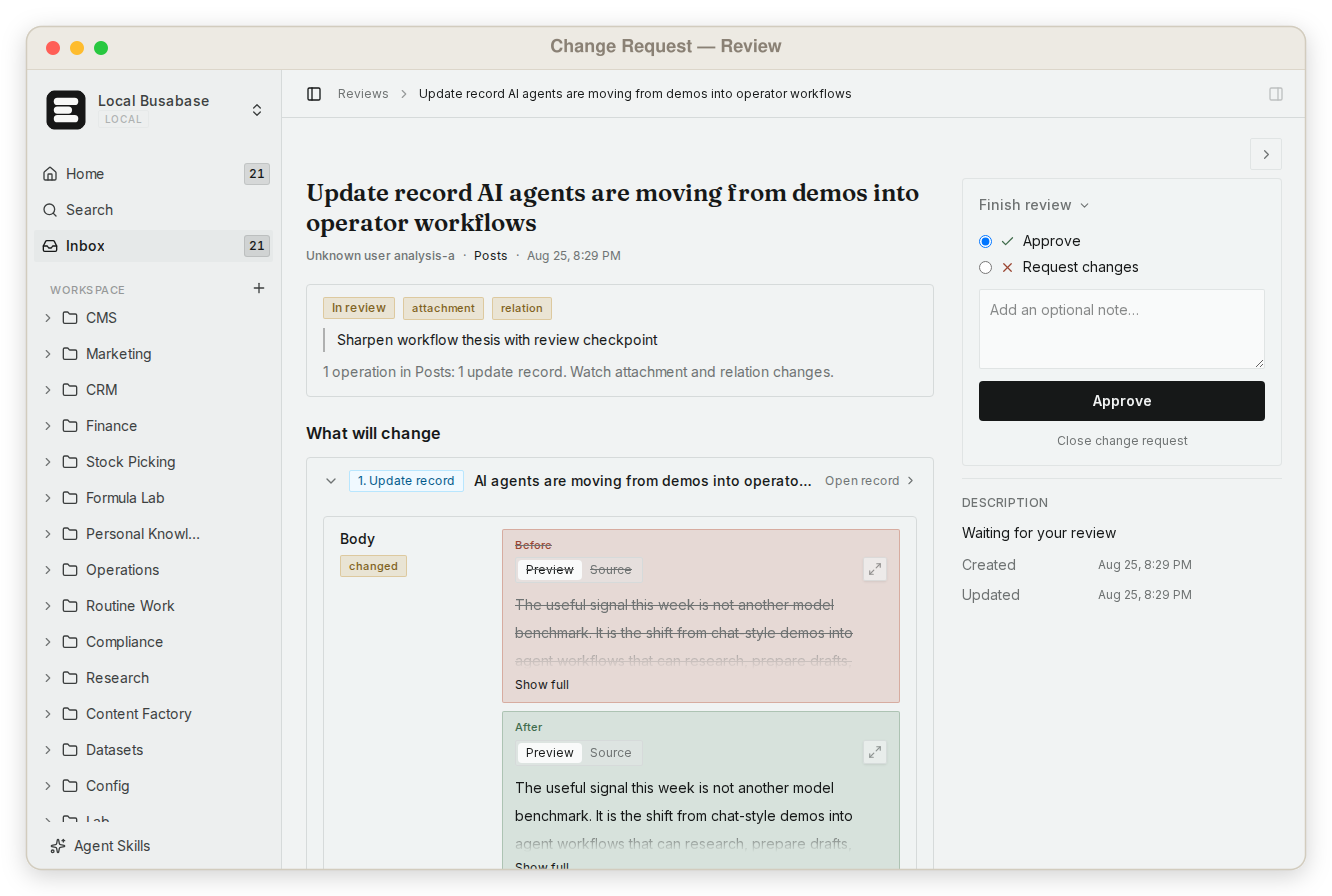
The difference in one line: Iris records what an agent did and why; Busabase records what your team decided — before it applies, if you want, and reversibly either way.
What else Busabase gives your agents and your team
A context engine serves agents. These are the things the people around those agents need, and in Busabase they come with the workspace.
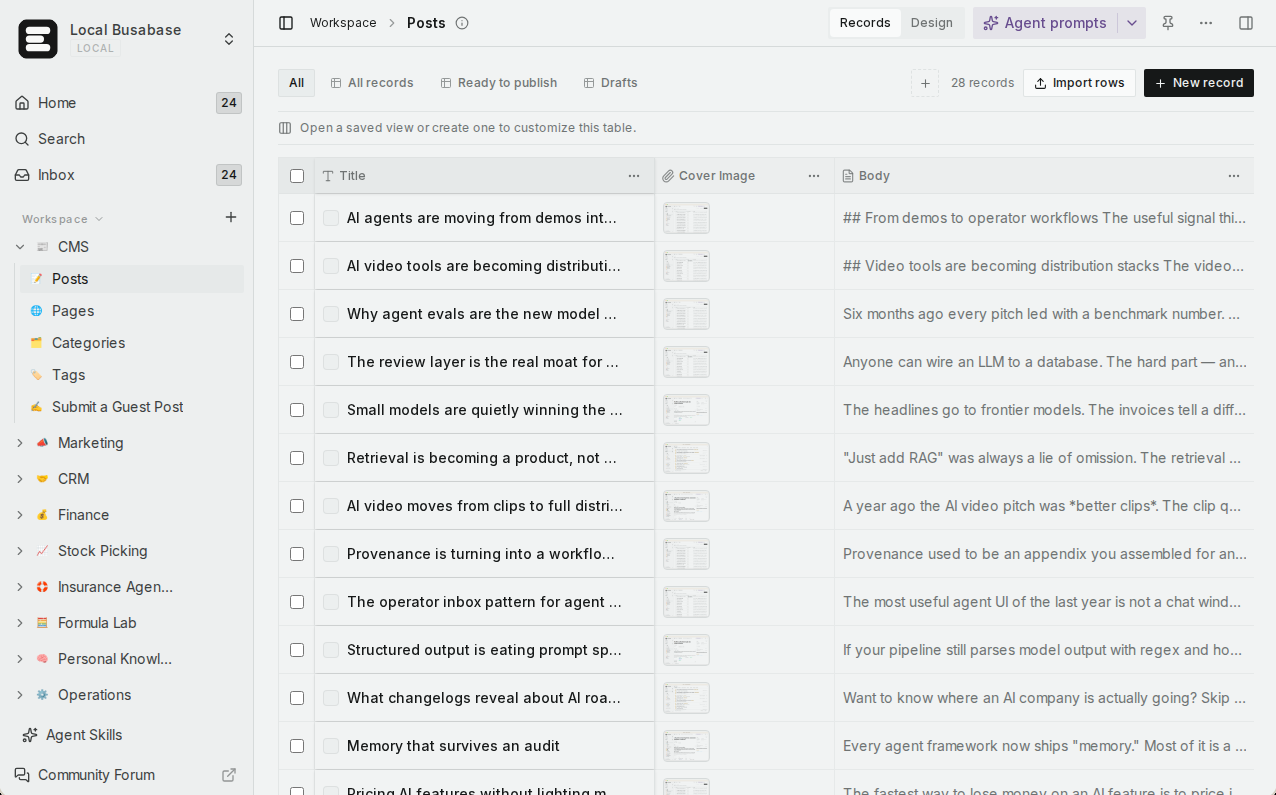
Visual data tables
A team knowledge base
Grep across everything
Skills you upload
Apps with four engines
Websites on your domain
Built for teams
Agents connect in minutes
Runs where your data has to
Comparison by the job you are trying to do
Rows are the jobs teams bring to these two products, not feature checkboxes. Where Redis Iris is the right tool, the table says so.
| What you are trying to do | Busabase | Redis Iris |
|---|---|---|
| See every change to your team's data before and after, and who made it | Built in — a Change Request with a field-level diff, the author and the agent key it came through, full history, and undo | Lens (beta) traces each agent outcome to its route, playbook, memory, and source session; Agent Memory keeps provenance for each memory |
| Let one agent propose changes without applying them | Yes — a proposal-only key; its changes wait in the Inbox for a person | For memory writes: ingestion webhooks can accept, reject, or transform them — self-managed deployments only, off by default |
| Let teammates read and edit what agents wrote | Yes — table, gallery, kanban, calendar, and Gantt views, no code | Built for developers: Agent Memory is reached through a Python SDK, a CLI, a REST API, or MCP |
| Keep the policy itself — the text people edit — as the source | Yes — Docs and records are the source; agents and people edit the same thing | Agent Memory extracts durable facts from conversations and documents; Agent Playbooks reuse answers and procedures |
| Run a team knowledge base | Yes — Docs, files, and Bases in one tree with shared permissions | Not a workspace: Context Gateway connects agents to data that lives in your other systems |
| Find exact text across everything | Yes — one regex grep across files, Doc bodies, records, and agent prompts, with line and context | Semantic search over long-term memory, narrowed with filters |
| Give every agent the same team Skills | Yes — upload the Skills your team writes; every connected agent reads the same version | Agent Playbooks hold FAQs and skills for reusable answers, with an optional learning loop |
| Turn the data into an app or a website on your domain | Yes — AirApps in the browser, on your machine, in a cloud sandbox, or as a website (custom domains on Plus and above) | Not a product feature |
| Invite teammates and agents into one workspace | Yes — members with read, write, or manage roles; agents join with their own keys | Not that kind of product; Context Gateway handles identity and authorization for agents reaching your data |
| Connect Claude Code, Codex, Cursor, and other agents | Yes — MCP, CLI, OpenAPI, webhooks, and agent plugins | Yes — Context Gateway is a single MCP endpoint, and Agent Memory has its own MCP server |
| Predictable pricing as the team grows | Flat per seat — no metered overage | Usage-based: per token, per tool call, and per message, plus the Redis database billed on its own plan; no seat fees |
| Self-host the whole product, including offline | Yes — MIT, from a laptop to an air-gapped network | Iris runs on Redis Cloud or on-prem; Redis Open Source itself is offered under RSALv2, SSPLv1, or AGPLv3 |
| Real-time context at production traffic: sub-millisecond caching, intent routing, session memory, vector search, agent-to-agent messaging | Not its job — use Redis | Yes — this is Redis's home ground |
Coming next
Three features are being built now. They are not available yet; we list them so you can plan, and this page will be updated when they ship.
App users In development
Ontology In development
Fine-grained permissions In development
Two kinds of system of record
Redis uses the phrase too. Its Iris page promises to “turn agent behavior from a black box into a queryable system of record,” and Lens delivers it: every outcome traces back to the skill, route, or FAQ that served it, the memory it learned from, and the source session. In a regulated business that trail matters — it answers “why did the agent do that?”
It does not answer “who decided the rule the agent followed?” Redis's own launch post opens with the case: a support agent “approved a $350 refund 45 days after a purchase when the policy explicitly states no refunds after 30 days.” Iris's fix is getting that policy into the agent's context in time. The policy itself still needs a home: one text people can open, a change history, and a name on every edit.
That home is Busabase. The refund policy is a Doc. When someone — or an agent — proposes 45 days instead of 30, it arrives as a Change Request with the exact before and after; a teammate reads it in the Inbox, merges it, and can roll it back next week. Lens records the agent's decisions; Busabase records the team's.
For the longer version of this distinction, read Agent memory vs knowledge base vs system of record.
Using them together
The two stack cleanly. A common split:
- Your team keeps policies, price lists, approved FAQ answers, and the Skills your agents follow in Busabase. Every change, from a person or an agent, is a Change Request.
- When a change merges, a webhook or an agent sends the updated Doc to Iris — Agent Memory's MemoryETL takes plain-text or Markdown documents, and a space exports to Markdown anyway.
- At run time Iris routes each request, recalls the customer, and reuses answers in milliseconds; the agent goes to Busabase when it needs the authoritative record in full.
- What the agent produces — research, drafts, updated customer notes — goes back into Busabase as Change Requests your team can read and undo.
Neither replaces the other. Redis Iris keeps agents fast and informed in production; Busabase keeps the records they draw on owned, readable, and reversible.
Pricing at a glance
Busabase
Plus: from $10 per seat per month (billed yearly). Pro: from $20.
Flat per seat, no metered overage. Self-hosting is free under MIT with no seat limit.
Redis Iris
Start: 5,000 messages free.
The Redis database is billed separately — Redis Cloud runs from a free 30 MB tier; Iris works with Essentials (from $5 a month) and Pro (from $200 a month) or on-prem.
Prices as published on 13 November 2026. Redis counts tokens only on what end users send to your agent. See Busabase pricing and Redis pricing (Redis Iris tab) for current details.
Where Redis Iris is the better choice
- Your agents serve live traffic and every millisecond counts. Redis built its name on sub-millisecond reads and writes, and Iris puts session memory, caching, vector search, and agent messaging on that engine — likely the one you already run.
- You are paying the model to answer the same questions again. Intent Router and Agent Playbooks recognise requests that mean the same thing and reuse the answer or procedure instead of a fresh LLM run.
- Your agents need memory across sessions and channels, and a trail behind each decision. Agent Memory extracts, summarises, and forgets on purpose; Lens shows which route, playbook, and memory produced each outcome.
Busabase's limits, plainly: it has no vector index, no semantic caching or intent routing, and it is not a per-turn memory service or a sub-millisecond hot path. It also has no realtime subscriptions, and sign-in for the end users of the apps you publish is in development (App users) but not available today. If your agents need that run-time layer, put Redis Iris alongside it.
Frequently asked questions
Is Busabase an alternative to Redis Iris?
Redis calls Lens a “system of record”. How is Busabase different?
Can Redis Iris review what goes into memory?
Does every agent write to Busabase need a human review?
How does the pricing compare?
Can I self-host Busabase? Can I self-host Redis Iris?
Next step
Connect an agent you already use and ask it to put one real piece of team knowledge into Busabase — a policy, a price list, a Skill. Then ask it to change something, and read the Change Request it produces.
Related reading: All comparisons · Busabase vs Mem0 · Busabase vs Zep · Which database for AI agents? · How Change Requests work
Sources: Redis Iris product page, Redis pricing (Redis Iris tab), “The next chapter of Redis Iris” (Redis blog, 3 Nov 2026), Redis Agent Memory (Redis docs), Agent Memory ingestion webhooks (Redis docs), Agent Memory MCP (Redis docs), Context Gateway (Redis), Redis licenses, “Redis is now available under the AGPLv3 open source license” (Redis blog, 1 May 2025), Busabase pricing