 Busabase × Cline
Knowledge base for Cline
Cline can carry project context through Rules and a Memory Bank, then protect local experiments with checkpoints. Busabase adds a separate promotion step for decisions that must outlive one task, one repository, or one Agent runtime.
Five different stores
Do not make one file solve behavior, memory, rollback, conversation, and governance.
Cline provides several persistence mechanisms. Each is valuable when it keeps a narrow job. A shared knowledge base starts where task-local or repository-local continuity stops.
Memory Bank lifecycle
A living project summary is useful precisely because it can change. That also makes promotion necessary.
Cline's Memory Bank uses regular Markdown such as projectbrief.md, activeContext.md, systemPatterns.md, techContext.md, and progress.md. The Agent can update these files after milestones. Before another team treats one statement as policy or current operational state, extract it into its own record with its source.
Cline updates activeContext or progress from the current task.
The owner checks code, issue, test, and external evidence.
One durable claim is separated from narrative and transient notes.
The claim, source refs, scope, and owner enter a Change Request.
The merged version becomes reusable across workflows, with every earlier version kept in its history.
Rollback is not approval
A checkpoint proves which files existed at a moment, not whether the result was correct.
Cline checkpoints use a shadow Git repository and can restore files, task messages, or both without changing the project's real Git history. They are a local safety net. Acceptance still depends on tests, source review, business impact, and an accountable person.
Promotion gate
Move stable facts out of the Memory Bank without turning Busabase into a second repository.
Keep implementation context and evolving project notes in the repository. Promote only information that needs structured queries, cross-project reuse, a responsible owner, or an audit trail.
Knowledge promotion record
One accepted claim needs a source chain, scope, and expiry behavior.
The record points back to the exact Memory Bank file, task, repository revision, and evidence. It does not copy every note Cline used to reach the proposal.
| Field | Purpose |
|---|---|
| knowledge_key | Stable identifier for the accepted claim |
| claim | One statement another workflow may rely on |
| source_ref | Memory Bank file, task, issue, or document |
| revision | Commit or immutable version reviewed |
| scope | Repository, service, customer, team, or environment |
| evidence | Tests, diffs, logs, and source URLs |
| decision | Accepted, conditional, rejected, or superseded |
| owner | Person accountable for accuracy and maintenance |
| review_at | When the claim must be checked again |
Cline has its own action controls
File approval, auto-approve, and MCP access do not grant canonical data authority.
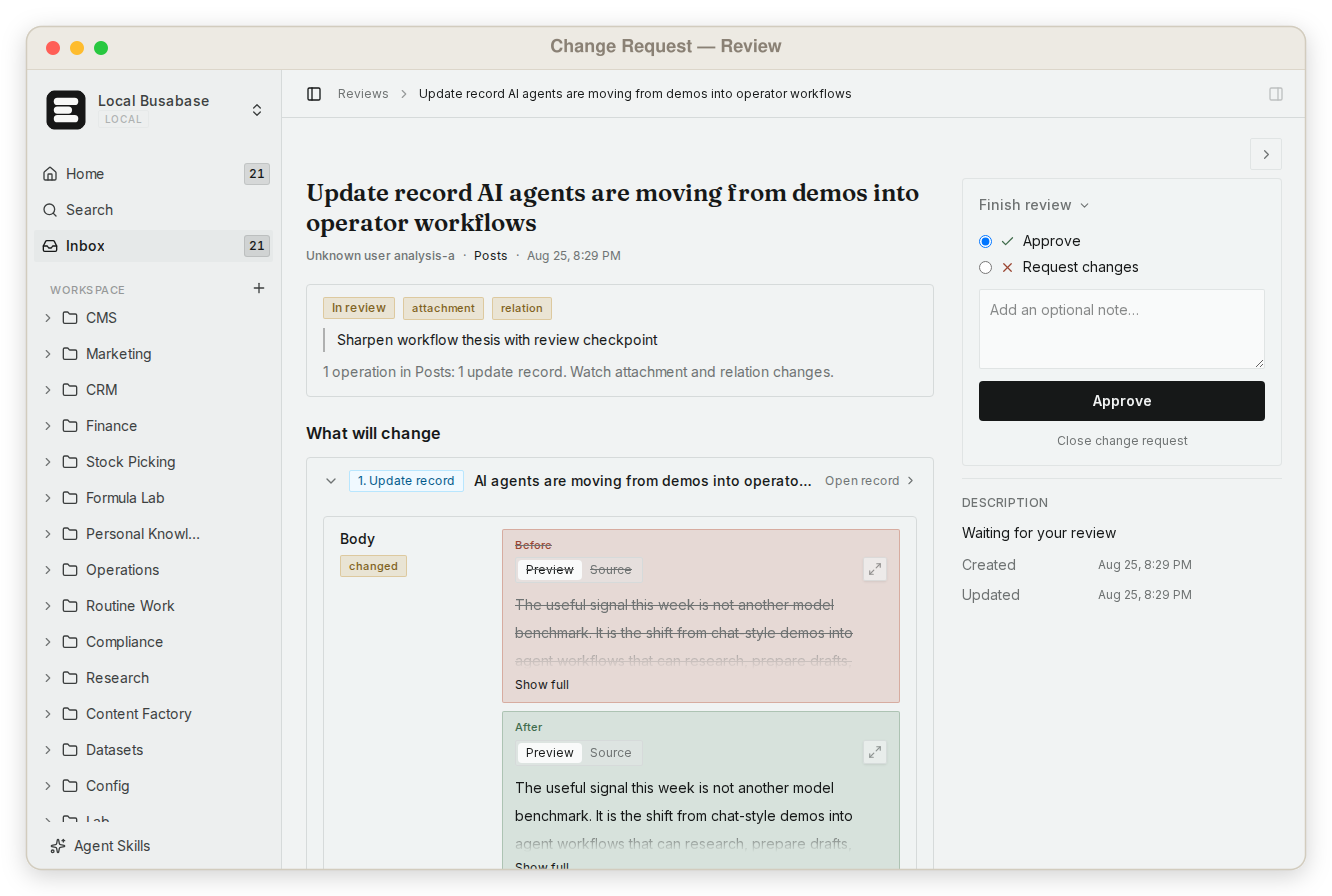
Cline can ask before file edits and commands, use auto-approve for selected operations, and call configured MCP tools. Checkpoints reduce the cost of local mistakes. For shared records you choose the second boundary: a write key merges Cline's Change Requests at once, a proposal-only key holds them in the Inbox.
Scope before connection
Decide which Cline surface and configuration scope owns the workflow.
Cline now spans IDE extensions, CLI, Desktop, Kanban, and SDK-based applications. Global and project Rules, Skills, Hooks, Agents, Plugins, and MCP settings live in different paths. Use the maintained connection guide, then record the surface, workspace, identity, and enabled tools for every governed workflow.
Questions from teams using Cline
Cline knowledge base FAQ
Does Busabase replace the Memory Bank?
No. The Memory Bank preserves structured project context in repository files. Busabase receives only selected claims that need ownership, history, structured queries, or reuse outside that repository.
Should Cline write every task result into Busabase?
No. Most task conversation, checkpoints, and implementation detail stay in Cline and Git. Propose only meaningful state, decisions, exceptions, or evidence required by another workflow.
Can a checkpoint serve as release evidence?
It can show a local file state, but it is not a release artifact or acceptance decision. Link the real commit, tests, build, deployment, and reviewer.
Can Cline update a canonical record with auto-approve enabled?
Auto-approve controls Cline operations, not Busabase permissions. Busabase decides by key: a write key merges Cline's Change Requests at once; a proposal-only key makes them wait for a person. Either way every change is attributed and reversible. How Change Requests work
Where should shared coding standards live?
Put executable Agent behavior in version-controlled Rules or AGENTS.md. Put organizational policy, ownership, exceptions, and change history in Busabase, linking the source rule when useful.
Promote one fact, not an entire memory folder
Give Cline continuity locally and accountable knowledge across the organization.
Choose one decision currently buried in activeContext.md or progress.md. Link its exact evidence, assign an owner, and check the first promoted record's diff and history.