 Busabase × Anthropic Claude Code
Knowledge base for Claude Code
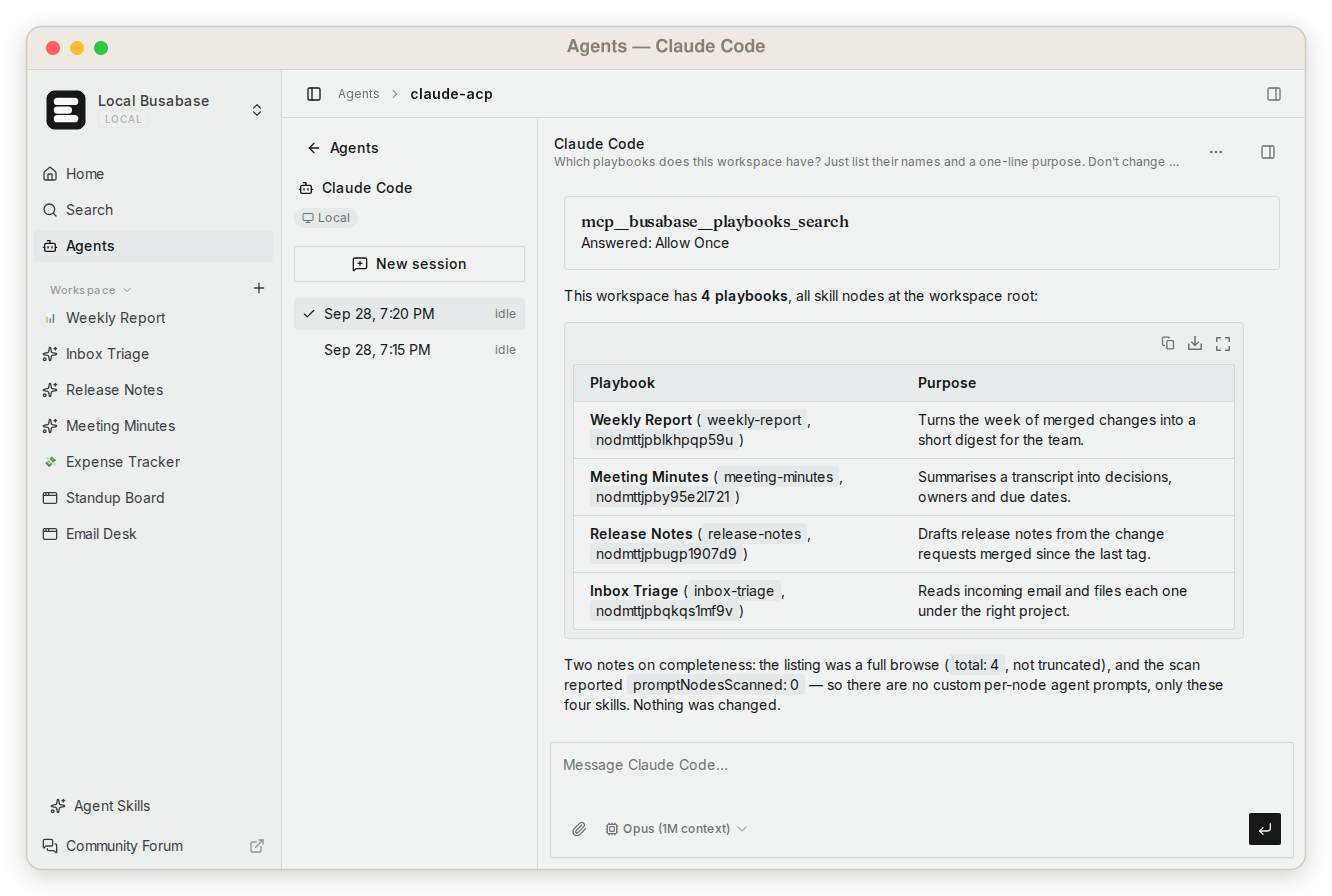
Claude Code can remember a project. Busabase gives the whole team a shared place, with a source and a history for every change, for decisions, evidence, and operational knowledge that must survive beyond one machine or one agent.
Three kinds of memory
Claude Code already remembers. The question is who should trust each memory.
Anthropic separates persistent instructions from auto memory. Busabase adds a third layer for knowledge that needs shared ownership, structured fields, sources, and an explicit path from proposal to accepted record.
Instructions
Coding conventions, build commands, architecture rules, and guidance Claude should see every session.
Owned by the repository and reviewed in Git.
Learnings
Corrections, preferences, and project patterns Claude records for later sessions on the same repository.
Owned by Claude Code and auditable as local Markdown.
Team records
Decisions, evidence, runbooks, release status, and business facts reused across agents, repositories, and applications.
Owned by the team, with every change attributed and reversible.
Promote, do not copy
Not every useful discovery belongs in the knowledge base.
Most session output should remain temporary. Promote a finding only when another person or agent will rely on it later and someone can identify the evidence behind it.
Claude finds a reusable fact
A constraint, decision, dependency, or incident lesson cannot be derived reliably from code alone.
Claude writes the claim and its source
The proposed Base fields make the intended future use visible before the record is accepted.
A person checks the consequence
If the change waits for review, the reviewer can correct scope, request evidence, reject the claim, or approve it for reuse. With a write key it merges at once and stays reversible.
The next session reads the accepted record
Claude no longer has to infer the same fact again, and the team can trace how it became trusted.
Parallel work
Give subagents a handoff ledger, not a shared pile of notes.
Claude Code can delegate work into isolated contexts. A structured Base gives those workers a common contract: what was investigated, what changed, what remains uncertain, and who accepted the result.
A Base that stays useful
Start with a decision register Claude can read and propose to.
A small schema creates a better memory than an unbounded document. Each field tells the next agent what it may rely on and what still needs checking.
| Field | Purpose |
|---|---|
| decision | The concise claim future agents may use. |
| evidence | Source links, test output, or the record behind the claim. |
| scope | Repository, service, customer, or environment where it applies. |
| owner | The person responsible for keeping it current. |
| verified_at | When the evidence was last checked. |
The Claude Code stack
Use each extension for the job it can actually govern.
Claude Code's extension layers work together. Busabase is the external system of record, not another always-on prompt file.
| Layer | Use it for | Control model |
|---|---|---|
| CLAUDE.md | Always-on project instructions | Repository review |
| Skill | On-demand knowledge and repeatable workflows | Skill source and invocation |
| Hook | Deterministic lifecycle enforcement | Executable policy |
| MCP | External tools and data access | Server permissions and authentication |
| Busabase | Shared records with history, beyond one repository | Change Requests, diffs, and merge history |
This division follows Anthropic's documented roles for CLAUDE.md, Skills, hooks, MCP, and subagents.
Connect the record layer
Keep setup on the setup page.
Install the Busabase Claude Code plugin for the maintained workflow, or use the connection guide for user, project, and local MCP scopes. Once connected, start with read access and one reviewable Base.
FIRST WORKFLOW
Architecture decision register
- Read
- Accepted decisions for this service
- Propose
- New decision with evidence and scope
- Review
- Owner checks consequence and freshness
- Reuse
- Next session starts from the accepted record
Questions teams ask
Claude Code knowledge base FAQ
Does Busabase replace CLAUDE.md or auto memory?
No. Keep instructions in CLAUDE.md and machine-local learnings in auto memory. Use Busabase when knowledge needs structured fields, shared ownership, sources, and a change history.
Can several Claude Code agents use the same knowledge base?
Yes. Agents can read the same accepted records while submitting separate proposals. Each write is its own Change Request, so parallel work never silently overwrites shared knowledge.
Can Claude Code write directly to Busabase?
Access follows the API key's permission level. A write key merges Claude's changes at once, each one recorded and reversible. To approve changes first, give Claude a Change Request (proposal-only) key so its edits wait in the Inbox. How Change Requests work.
Should architecture decisions still live in Git?
Keep code-owned artifacts in Git. A Busabase decision register is useful when the same decision also guides other repositories, support, operations, product work, or non-code applications.
Is this just vector memory for Claude Code?
No. Vector retrieval finds related passages. Busabase records who proposed a structured change, what evidence supported it, which key it came through, and which value became canonical.
Turn one correction into team knowledge
Let the next Claude Code session start from an accepted decision
Create one small Base, connect Claude Code, and promote only the findings your team is prepared to reuse.