 Busabase × Agent Zero
Knowledge Base for Agent Zero
Agent Zero can isolate files, instructions, secrets, memories, knowledge, repositories, and model presets by project while delegating work to focused subagents. Busabase is the narrower layer for facts that must cross those project boundaries with evidence, ownership, and a change history anyone can inspect or roll back.
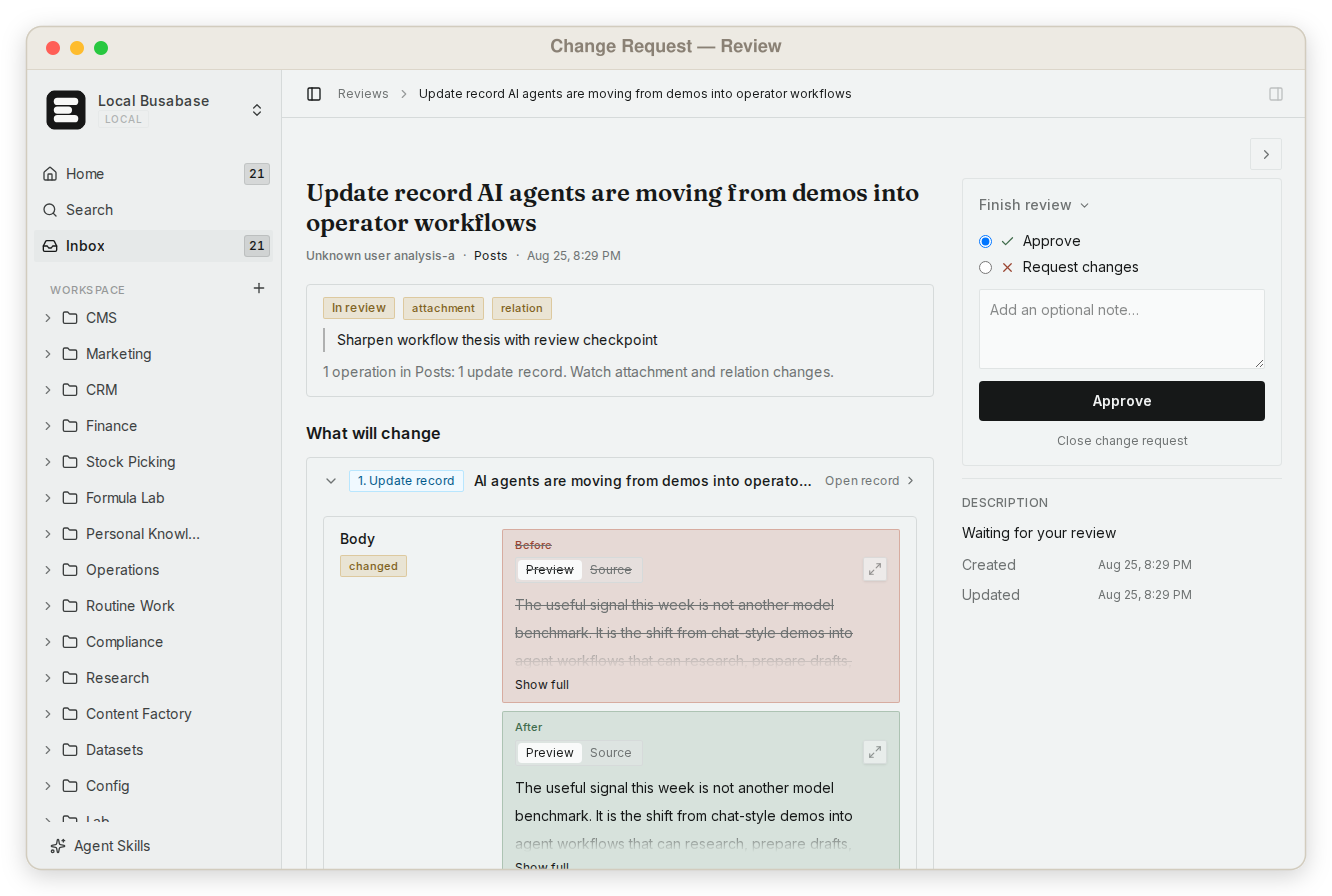
Project isolation
A project keeps context from leaking; it does not make every project memory authoritative.
Agent Zero Projects isolate workspace files, instructions, memory, secrets, knowledge, repositories, and model-preset choices. Preserve that boundary. Promote only the claims that another project or team genuinely needs.
| Project asset | Local purpose | Cross-project rule |
|---|---|---|
| Workspace files | Task inputs and generated artifacts | Link immutable outputs |
| Instructions | Project-specific Agent behavior | Do not store changing status |
| Memory | Useful learned context | Curate before promotion |
| Knowledge | Imported and searchable material | Retain source and freshness |
| Secrets | Project credentials | Never copy into knowledge records |
| Repositories | Code and revision history | Reference Git instead of duplicating |
| Model presets | Execution configuration | Record model/runtime only as provenance |
Memory and knowledge
Recall improves continuity, but stale memory can poison every later step.
Agent Zero's own guide describes memory as useful remembered information from conversations and imported knowledge, and tells users to search, review, edit, remove, and back up entries. Treat curation as routine operations rather than assuming recall is self-correcting.
Delegated work
A subordinate Agent returns a result, not an independent source of authority.
Multi-agent cooperation can delegate research, coding, analysis, or review to focused subagents. Preserve the delegation tree and the evidence each worker actually produced. The parent summary alone should not erase uncertainty or conflicting findings.
Skills and profiles
Skills teach procedures; Agent Profiles configure behavior; neither should own changing operational facts.
Agent Zero exposes inspectable prompts, tools, plugins, Skills, settings, and model presets. Skills may load on demand or remain pinned for a chat. Keep repeatable execution knowledge there, and make each procedure query current Busabase records when facts change.
SKILL
Reusable task procedure and support files
AGENT PROFILE
Role, prompts, tools, and model choices
BUSABASE RECORD
Current inputs, decisions, and ownership, with history
Container and host boundary
Record where the action actually ran, not only which Agent requested it.
Agent Zero commonly runs in Docker and can use A0 CLI to reach host terminal, files, browser, and real repositories. Container output, host output, and external service responses have different trust and reproducibility properties.
Agent runtime, project workspace, isolated tools
Real repository, terminal, browser, local files
API or service state reached by a tool
Evidence-backed claim with an owner and an attributed history
Memory operations
Keep durable context small enough to inspect and easy enough to correct.
Review memory when behavior repeats a mistake or recalls the wrong context. Remove test data, update inaccurate entries, keep project-specific information in project memory, and back up before large cleanup.
Cross-project promotion
Do not copy an entire memory directory into a shared knowledge base.
A promotion should narrow one useful claim, attach its source and runtime evidence, identify the responsible owner, and define when it needs another review.
Agent knowledge contract
Preserve enough lineage to challenge a claim after the original chat or subagent is gone.
The record links project-local context to the stable state shared across projects.
knowledge_keyStable identity across projects and Agentsproject_refOrigin project and workspaceagent_treeParent and subordinate Agent referencesmemory_refsEntries or imported knowledge usedexecution_surfaceContainer, host bridge, or external serviceartifact_refsFiles, repository revisions, logs, and responsesclaimConcise proposed cross-project stateownerPerson accountable for acceptancefreshnessObserved, effective, and next-review datesdecisionAccepted, conditional, rejected, or superseded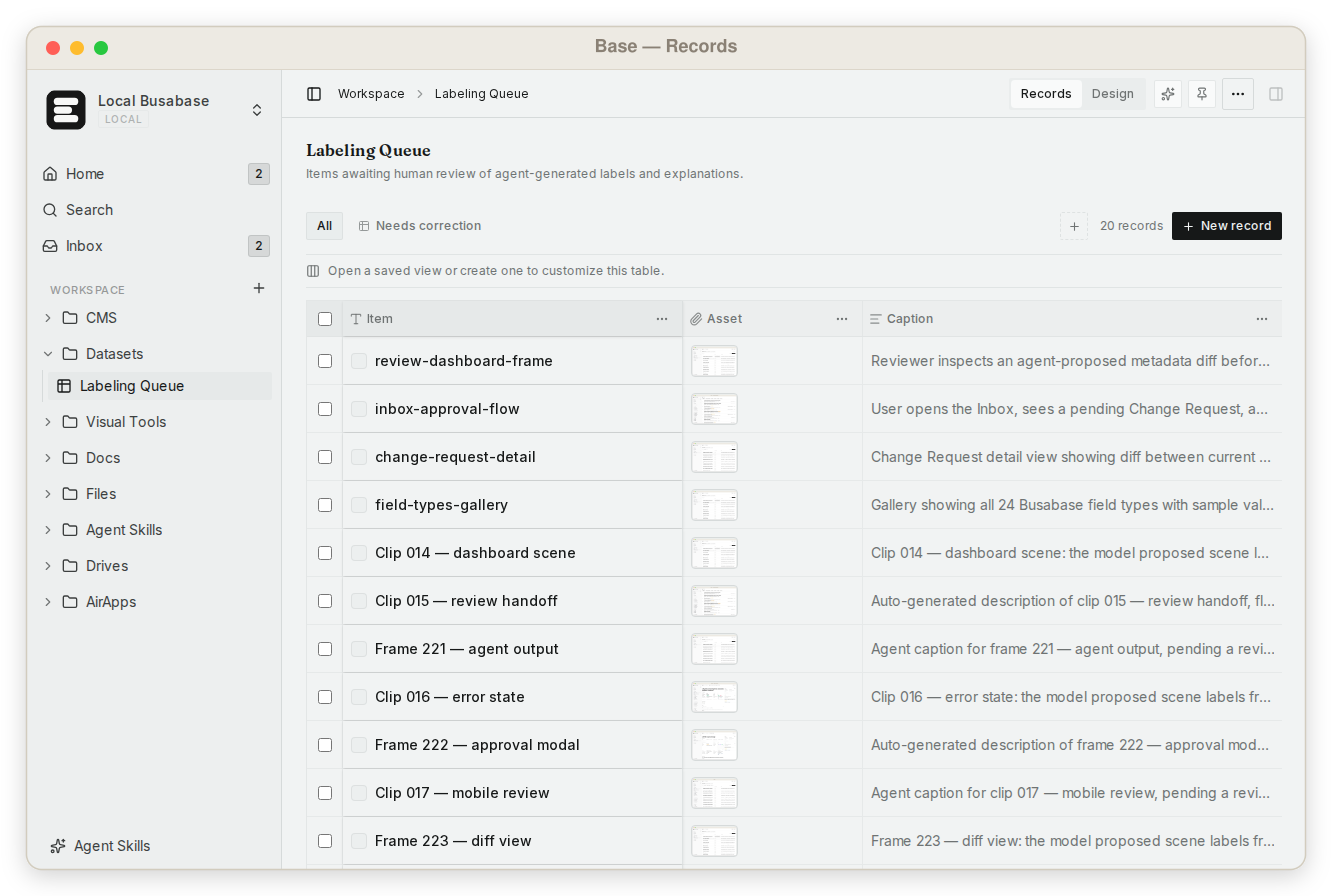
Trust boundaries
A powerful host bridge increases evidence requirements, not authority.
Projects isolate context, but tools can still affect repositories, files, browsers, and services. Use least privilege, inspect shell commands and authorization flows, and separate the ability to execute from the authority to merge shared records when that matters to you.
| Boundary | Control |
|---|---|
| Project boundary | Prevent unrelated memories, secrets, and files from mixing |
| Tool boundary | Limit terminal, filesystem, browser, and service access |
| Credential boundary | Grant only the required account and scope |
| Change boundary | Every write is an attributed, reversible Change Request |
Practical questions
Agent Zero knowledge base FAQ
Does Busabase replace Agent Zero memory?
No. Agent Zero memory supports one project's continuity. Busabase stores selected facts, with their source and change history, for use across projects, people, and Agents.
Should imported knowledge be treated as current?
Not automatically. Preserve its source and freshness, then review any claim that becomes operational state.
Does a subagent result count as independent verification?
Not by itself. Record its sources, execution context, and unresolved conflicts before promotion.
Should Skills contain current customer or production status?
Usually not. Keep the procedure in the Skill and retrieve changing facts from Busabase records.
Can Agent Zero merge canonical records directly?
With a write-level key it can; each change is still a Change Request with a diff, author, and rollback. If you want a person to approve first, give it a proposal-only key so its changes wait in the Inbox. How Change Requests work
Start with one project-local memory
Promote the smallest fact that another project truly needs.
Choose one curated Agent Zero memory with durable evidence. Identify its project, execution surface, owner, and freshness rule, then propose it as a Change Request for cross-project reuse.