Paperclip already manages agents. When is a separate knowledge base useful?
Evaluate documents, approvals and export boundaries before adding an independent information layer.

When tasks, documents, approvals and history already live in Paperclip, adding another information system should solve a concrete problem: which business material needs to outlive a task and become an accepted source for other executors?
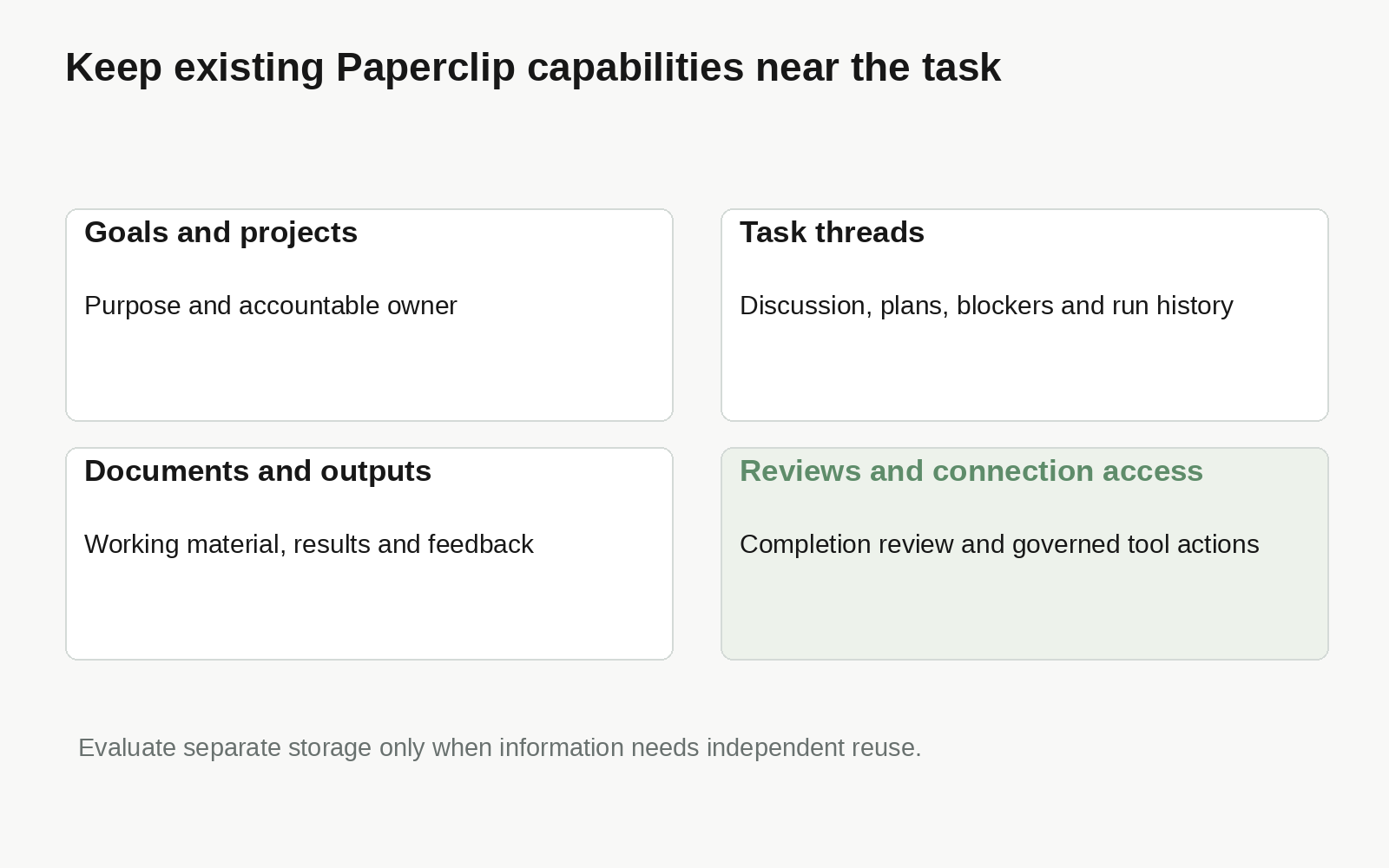
Paperclip's project documentation lists task threads, documents, approval and review gates, permissions, shared Skills, run history and governed connections. These are substantial collaboration capabilities. For agents working within the same organization and task environment, they may already be sufficient.
Evaluate Busabase against a missing information path, rather than assuming that every multi-agent team needs another knowledge system.
Use the task environment you already have
Paperclip links tasks to projects and goals. Threads retain discussions, plans, blockers, files and run history. Documents and work products attach to the work; teams can inspect outputs, leave feedback and configure completion reviews or connection-action approvals.
The reason a task exists, its assignee, its output and permission to proceed generally belong there. Duplicating those objects in another database creates another set of statuses to reconcile.
First check whether later tasks can reliably locate a frequently used policy, whether an update owner is clear, and whether a handoff identifies the currently effective version. If the existing documents and process answer those questions, keep using them.
Separate the objects being accepted
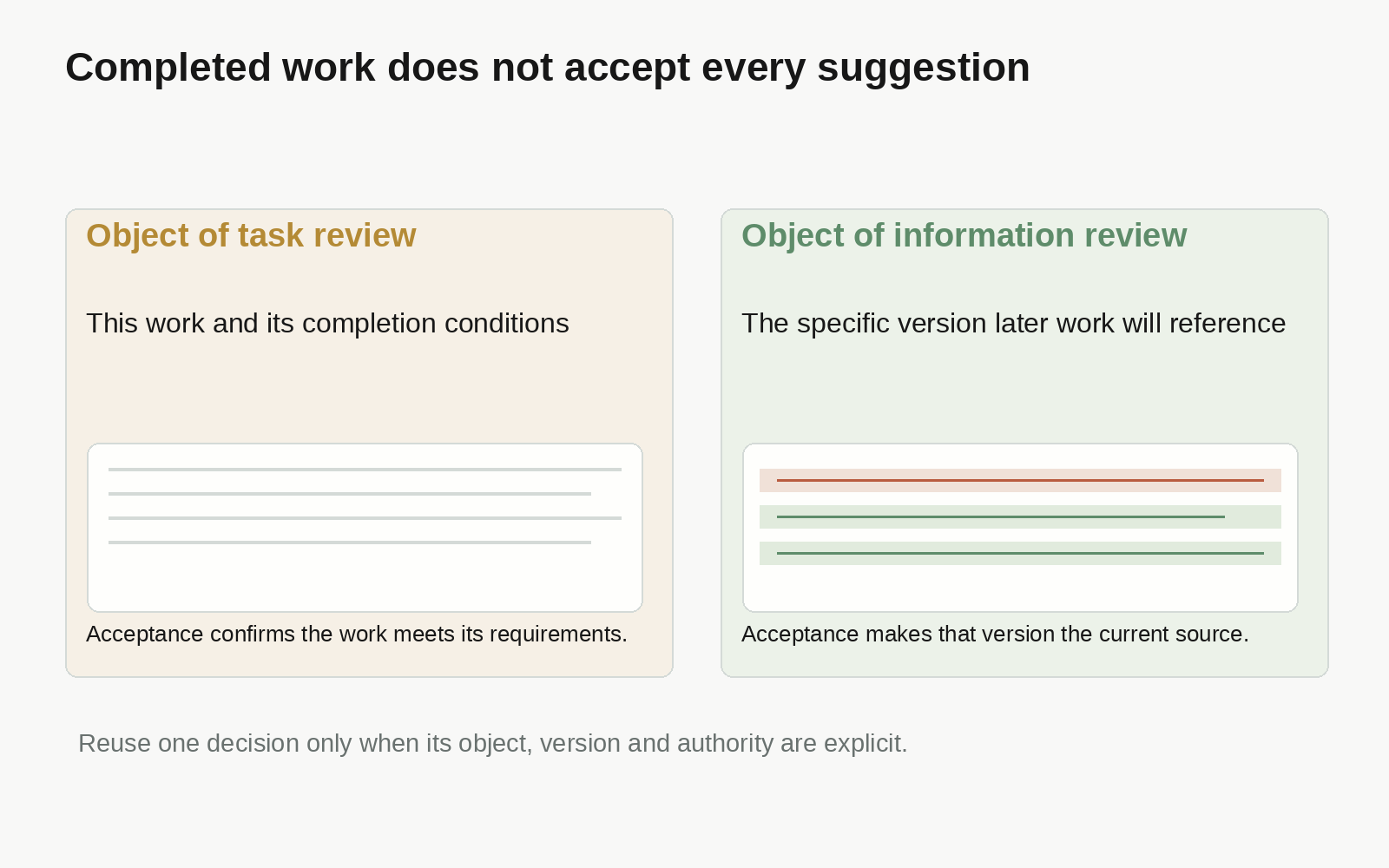
Task acceptance asks whether a particular piece of work meets its completion conditions. Acceptance of a business record asks whether a proposed statement should become the source later work relies on. These decisions can happen inside one product or across systems.
A research task can be complete while a proposed policy revision still needs the fact owner's decision. Later agents should use the accepted policy rather than treating every suggestion in a completed task as an effective rule.
This distinction is not evidence that Paperclip lacks approvals. Inspect your current document, version and approval rules. If they distinguish proposed and current material, and all consumers work within that environment, an extra layer may have little value.
The question changes when a policy must also serve another agent client, a website or an external business process. You then need a stable read interface, explicit identities allowed to propose edits, and a clear decision about when an edit becomes effective.
Portability has a documented boundary
Paperclip provides company export and import. Its official guide describes packages carrying agents, projects, Skills, tasks, comments, documents, work products and attachments. The UI previews package contents before download or import.
The same guide says that approvals, cost history and activity logs remain on the source instance. Before migration, inspect the export page's excluded-data panel and plan retention for the history you need. Company packages and full-instance backups serve different recovery needs.
Being able to export documents does not settle how review history will be retained. An export boundary also does not automatically justify an external database. Identify the required records, retention period and readers first, then choose the appropriate migration or storage approach.
Three concrete reasons to evaluate a separate layer
One reason is cross-tool consumption: a policy needs to serve executors outside Paperclip without separately maintained uploads. Another is structure: the material has fields such as product, applicability, evidence, effective date and owner that need consistent querying. A third is independent acceptance: proposing and accepting business changes should have permissions separate from closing a task.
These are evaluation conditions, not mandatory requirements for every team. Another service means maintaining connections, handling unavailable reads and confirming that downstream consumers see updated content. If that work exceeds the ambiguity it removes, retain the existing setup.
A minimal accepted-record path using Busabase
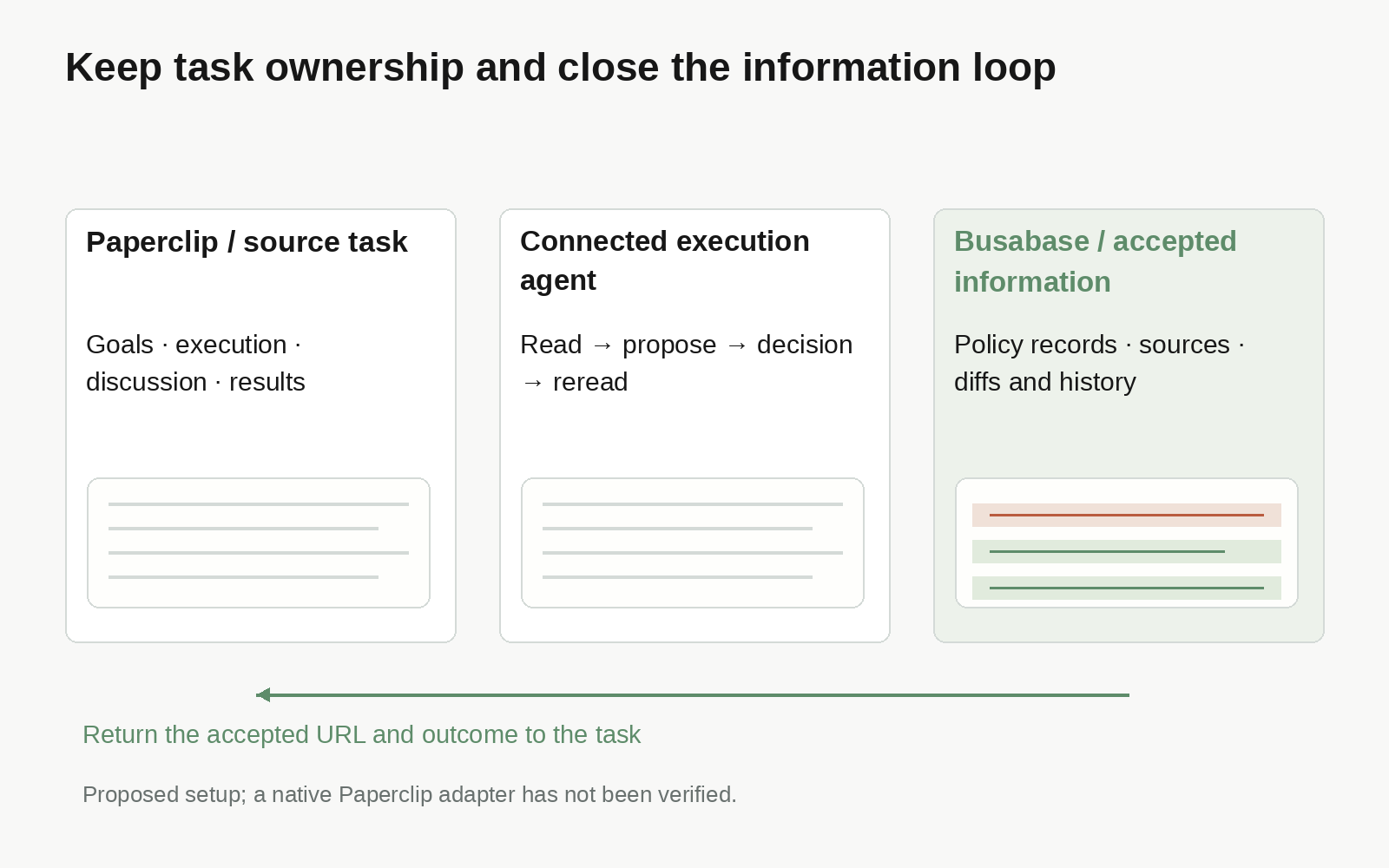
Paperclip can continue to own organization and task execution while Busabase stores selected business records for independent reuse. This article does not establish a tested native Paperclip adapter. Use a supported client connection from the actual executor, or implement and validate an integration. Both systems mentioning MCP does not complete that configuration.
A starter design could be:
| Node | Suggested contents | Relationship |
|---|---|---|
| Base: Business policies | Name, text, scope, source, owner, effective date | Current accepted business information |
| Base: Information-change tasks | Problem, related policy, source task URL, owner, output URL | Trace proposed work to its task |
| Doc: Review rules | Evidence and acceptance criteria | Explain who decides what |
| Skill: Policy maintenance | Read, propose, reread and report back | A method for the connected executor |
Avoid manually duplicating the product's audit history. Busabase ChangeRequests already retain changes and status; merge advances the current record while immutable commits preserve earlier content. Use changeRequest permission when an ordinary agent should propose rather than accept. With write permission, a proposal may merge immediately.
A connected executor can receive this instruction:
Read the current linked policy and the source task materials. Preserve the accepted text while proposing a revision with evidence and affected scope. After the owner approves and merges it, reread the record and return the accepted URL and outcome to the original task. Keep unaccepted suggestions separate.
Walk through one policy manually before scheduling it. Expected outputs include the current record URL, the change proposal and the source task link. An agent's completion message alone does not establish the accepted state.
Begin with one information decision
Material explaining one task is often easiest to understand beside that task. For repeatedly reused information, first test finding, versioning and permissions in your existing Paperclip configuration. Add another layer only when cross-tool consumption, structured access or an independent acceptance process gives it a specific job.
Should all Paperclip tasks move to Busabase?
No. Keep orchestration, run logs and organizational governance with the existing system. Select the business material that needs independent reuse and preserve source task links rather than maintaining two task queues.
Does a completed review require another policy review?
Check whether both decisions concern the same object and version. If task review explicitly accepted that policy version under the owner's rules, reuse the decision. If it accepted only task completion or a tool action, obtain the remaining decision required to make the policy effective.